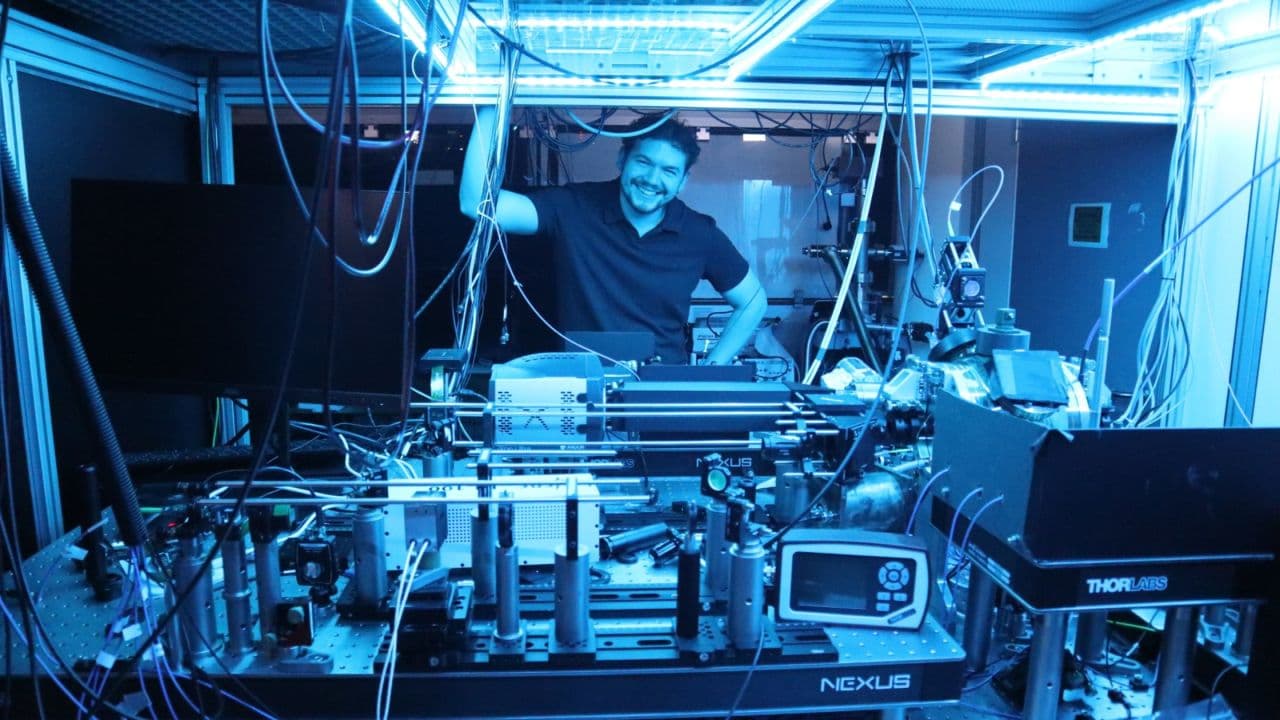
EpoQ wins PhotonDelta's 2026 Global Photonics Engineering Contest
Amsterdam venture to take trapped-ion atomic clocks out of the lab, into the field
Congratulations to UvA-IoP based quantum technology venture EpoQ! The pre-incorporation venture led by Louis Gallagher, Rene Gerritsma and Matteo Mazzanti that aims to develop compact and deployable quantum clocks, won PhotonDelta's 2026 Global Photonics Engineering Contest, with up to €100,000 of technology support and opportunity for up to €2 million investment.
From laboratory to real world
Trapped-ion atomic clocks are among the most precise timekeepers in the world. Today they depend on large, complex laboratory setups, which keeps them out of most real-world settings. EpoQ is using integrated photonics to cut the size, weight and power needs of these clocks dramatically, so they can be used in satellites, defence systems and precision metrology.
The work addresses a growing vulnerability. Navigation and communication systems rely on accurate timing, often delivered by satellite signals that can be jammed or spoofed. A compact, deployable atomic clock could make timing and navigation more resilient for platforms such as naval vessels and satellites, and open up uses where today's high-performance clocks are too bulky or power-hungry.
According to CEO and co-founder Louis Gallagher, the win gives the team access to the photonics capabilities and expertise needed to speed up development for space, defence and critical infrastructure applications.
A strong international field
Organised by PhotonDelta with Wevolver, the second edition of the contest drew entries from 18 countries, up around 18% on its first year. Submissions spanned communication and computing, sensing, imaging and wireless, and were assessed on innovation, technical and commercial feasibility, and relevance to current industry challenges. The jury picked EpoQ for pairing an ambitious use of integrated photonics with a credible answer to a clear market need.
What's next
EpoQ will receive up to €100,000 in technology services from companies across the PhotonDelta ecosystem, and may be eligible for up to €2 million in pre-seed funding, subject to PhotonDelta's investment process. The prize also includes a pitch slot at a major international tech event and international PR support.
Read the full announcement on the PhotonDelta website.
I paraphrased Gallagher's statement rather than lifting PhotonDelta's quotes. If you can, a fresh line from Louis, Rene or Matteo about building this in Amsterdam (UvA, the local quantum ecosystem) would give the piece a QDNL Amsterdam angle that the PhotonDelta release doesn't have.
Sources: PhotonDelta – EpoQ wins 2026 Global Photonics Engineering Contest
Related news

Three new quantum research positions open in Amsterdam

AI for Math Fund grants 1M to Amsterdam researchers Krystal Guo and Ross Kang
ERC Starting Grant awarded to CWI researcher Jonas Helsen who works on quantum error correction

Veni grant for researcher into quantum-resistant digital locks
HoQ Amsterdam: a new co-working space for quantum at Science Park

2024 Physica Prize awarded to Amsterdam Researcher Florian Schreck