
Three new quantum research positions open in Amsterdam
Amsterdam's quantum research community is growing. The University of Amsterdam and CWI have opened three positions spanning quantum applications in the life sciences, the theory of bosonic quantum computing, and testing and learning algorithms for fault-tolerant quantum computers. Here is an overview of each role and when to apply.
Postdoc in Quantum Computing for Bioinformatics, University of Amsterdam
Closes 31 October 2026
The Biosystems Data Analysis (BDA) group at UvA's Faculty of Science is looking for a postdoctoral researcher to develop and benchmark quantum and hybrid quantum-classical approaches to problems in bioinformatics. The project is one of four seed projects in the Faculty's new Quantum Simulation for Molecular and Material Design (Q-MMD) programme.
The researcher will focus on one or both of two directions: protein structure-based enzyme specificity and biocatalysis, and DNA sequence analysis for microbiome and human-microbiome research. A central part of the work is honest benchmarking: comparing quantum prototypes against strong classical baselines and reporting both opportunities and limitations.
Candidates with a background in either quantum computing or bioinformatics are welcome. The group explicitly does not expect applicants to be experts in both fields from day one. The position is for 18 months (38 hours per week), with a gross monthly salary of €3,706 to €5,760.
Postdoc in Characterisation, Learning and Testing of Bosonic Quantum Computers, CWI
Closes 15 November 2026
QuSoft, the Dutch research centre for quantum software based at CWI, is hiring a postdoc to work on the theoretical computer science of bosonic quantum computing. Bosonic systems have advanced quickly in the lab, but theory has lagged behind. This role will address property testing, learning theory and characterisation of bosonic systems, as well as their classical simulation.
The position is part of the QuantERA consortium Batir-le-chat, which brings together researchers from the Netherlands, Germany and France. The appointment is for one year, with an option to extend by 1.5 years, and a gross monthly salary of €4,374 to €5,758.
Questions can be directed to Dr. Jonas Helsen (jonas@cwi.nl) or Dr. Freek Witteveen (f.witteveen@cwi.nl).
PhD in Testing and Learning Algorithms for Fault-Tolerant Quantum Computers, CWI
Closes 10 December 2026
As quantum computers scale up, characterising their errors and noise efficiently becomes essential. This PhD position, part of Dr. Jonas Helsen's ERC Starting Grant project EQUATE, focuses on developing and mathematically analysing new testing and learning algorithms and how they interact with quantum error correction.
Possible research directions include:
testing and learning in the "low-magic" setting
testing for properties relevant to error correction, such as membership of the Clifford hierarchy
how logical noise affects learning algorithms
The project offers the chance to take theoretical results toward practical settings, potentially down to real experiments. Candidates need a Master's degree in physics, computer science, mathematics or a related field, along with demonstrated interest in quantum computing. The target start date is 1 March 2027.
For all three positions, evaluation of candidates begins immediately, so early applications are encouraged.
A few things to fill in before publishing: the apply links are placeholders, since the postings didn't include direct vacancy URLs. You may also want to add a header image and a closing line linking to QDNL's other job listings, if you have one.
Related news

AI for Math Fund grants 1M to Amsterdam researchers Krystal Guo and Ross Kang
ERC Starting Grant awarded to CWI researcher Jonas Helsen who works on quantum error correction
Veni grant for researcher into quantum-resistant digital locks
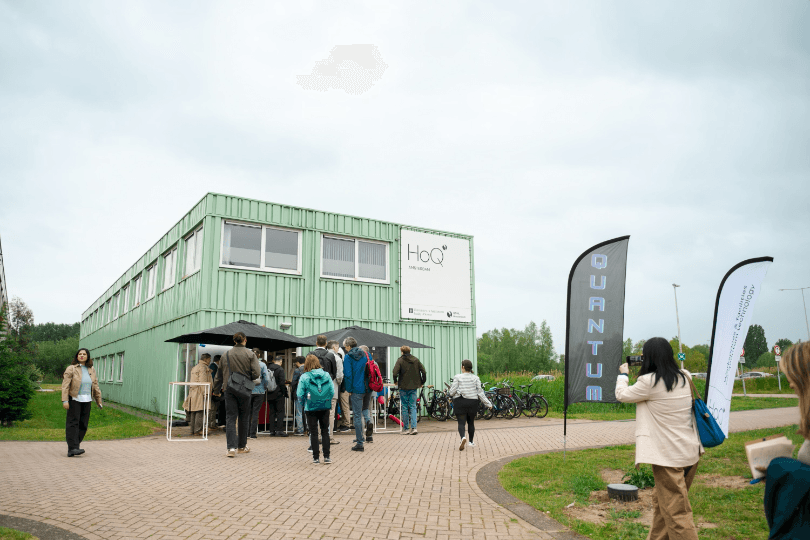
HoQ Amsterdam: a new co-working space for quantum at Science Park
2024 Physica Prize awarded to Amsterdam Researcher Florian Schreck
Masterclass Introduction to Quantum Computing